
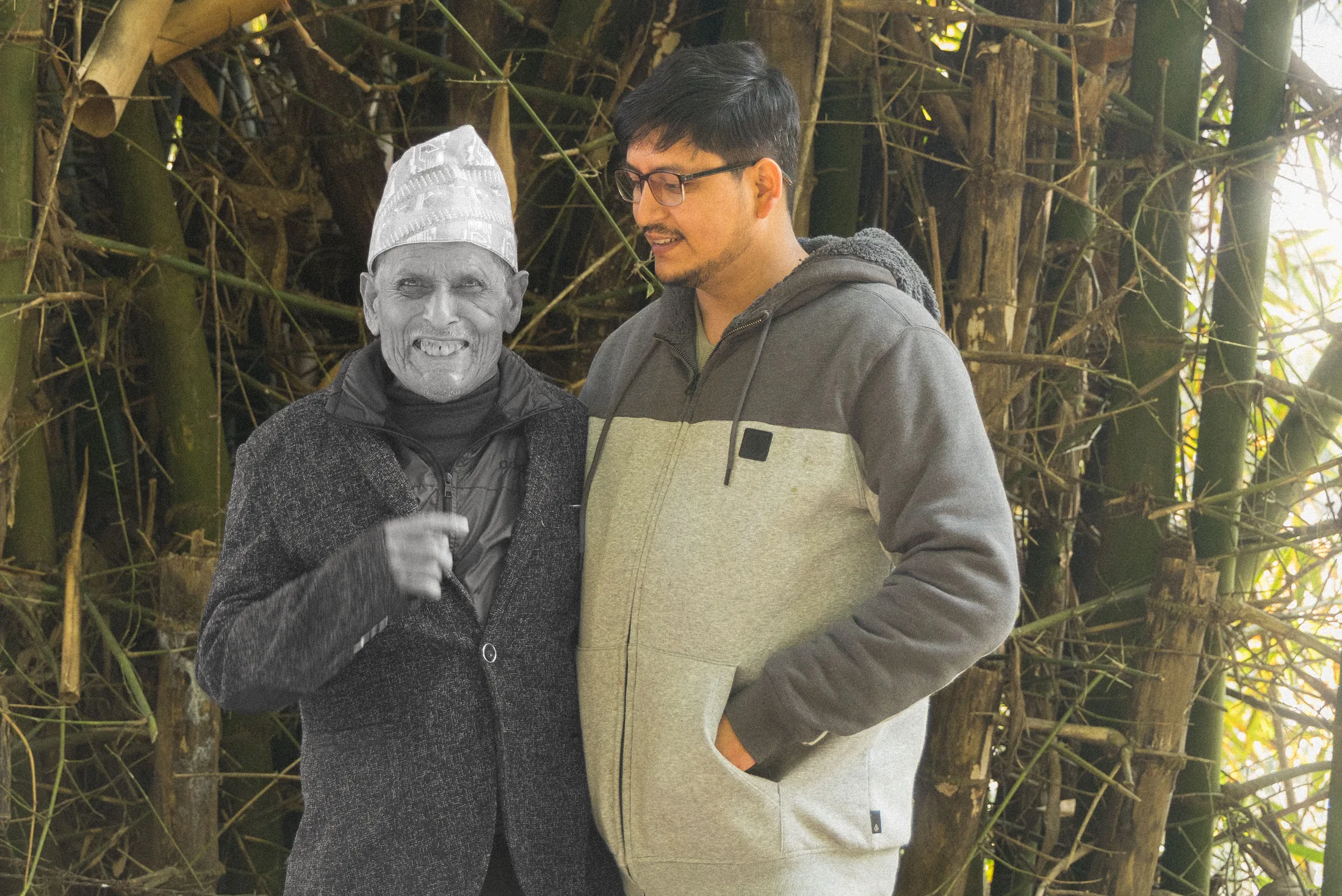
Some memories fade with time. Others grow more meaningful as we grow older.
This is one of those memories.
It must have been around twenty years ago. My brothers and I were perhaps eleven or twelve years old, maybe younger. I cannot remember our exact ages, but I remember the excitement of going to Mama Ghar — our maternal grandparents' home.
For us children, Mama Ghar was almost like a little paradise.
There was freedom, good food, endless love, and, most importantly, school holidays without too many rules!
Sometimes our mother would join us later. Sometimes she wouldn't come at all. And as children, that meant even more freedom. What more could we possibly want?
Getting there, however, was an adventure of its own.
We could take a bus for about two hours and then walk uphill for another four hours. Or we could simply walk from our home, which took roughly six hours altogether.
These days, a bus journey might sound ordinary. But back then, for a family with very little money, travelling by bus was something special. It was exciting, almost a luxury. And if you were lucky enough to get a seat, well, that was another luxury altogether!
Our Jiba, my mother's father, would sometimes come to our home to collect us and take us to Mama Ghar.
And one particular school holiday, he came to pick us up again.
I remember him telling us that we would take the bus.
Imagine our excitement!
But Jiba, as it turned out, had a different plan.
He knew another way, he told us. And being children, we simply followed him.
We walked.
And walked.
And kept walking.
After what felt like more than two hours, tired and hungry, we finally stopped at a small roadside food hut.
It wasn't a restaurant like the ones we know today. Just a humble little place beside the road, with wooden benches and traditional woven bamboo stools called muda.
But those little roadside huts had something that many fancy restaurants today cannot recreate: fresh, simple food, made with warmth and served without pretence.
There would be hot sel roti, chana tarkari, kerau tarkari, alu-kerau, doughnuts, malpuwa, and steaming cups of milk tea. Nothing extravagant, nothing complicated. Just the kind of food that could make a hungry traveller feel like the luckiest person in the world.
I remember Jiba ordering tea and doughnuts for us.
We were exhausted. Perhaps we had complained along the way. Perhaps one of us had even cried. I honestly cannot remember.
But what happened at that little roadside hut has stayed with me for almost twenty years.
Jiba taught us something that day. Something I was too young to fully understand, but old enough to remember.
I cannot recall his exact words, so I will not pretend that I can. But I remember what he wanted us to understand.
When you travel on foot, your legs may hurt. You become tired. The journey might feel long, and sometimes you wish you had taken the easier road.
But something beautiful happens when you walk.
You begin to notice the world.
You feel the fresh air against your face. You see the trees, the grass, the birds, and sometimes wild animals. You hear sounds that you would never notice from inside a moving vehicle. You cross little streams, feel the sunlight, and experience the changing landscape.
You become part of nature rather than simply passing through it.
And somewhere along the way, without even realising it, your mind becomes quieter.
You are no longer thinking only about reaching your destination.
You are experiencing the journey itself.
Jiba wanted us to understand that travelling was not only about getting from one place to another.
It was about seeing, feeling, tasting, learning, and discovering.
He also explained something practical.
The money we might have spent on the bus could instead buy us delicious food along the way. Food we would not normally have at home. Something different from our usual dal bhat. A new taste, a new smell, a new experience.
We didn't have much money, but that didn't mean we couldn't experience something wonderful.
Looking back, I realise that Jiba was teaching us how to find richness in a life that didn't have much money.
He believed that we should travel whenever we had the opportunity, and while our bodies were still able.
There might come a time, he reminded us, when we would be too old, too weak, or too unwell to go wherever we wished.
And then there was another thought of his that has remained with me all these years:
When you travel, you become a storyteller.
Because you have seen places, met people, tasted unfamiliar foods, walked different roads, and witnessed the beauty of this earth.
You have something to remember.
And something to share.
At that age, I probably cared more about the doughnuts and getting to Mama Ghar than understanding his philosophy.
But as I grew older, his words began to make sense.
Sometimes, completely unexpectedly, that little conversation would return to my mind.
And every time it did, I understood it a little differently.
Perhaps that is one of the most beautiful things about growing older. You begin to understand lessons that were given to you long before you were ready to receive them.
I cannot say that I have travelled the whole world. Far from it.
There are countless places I have yet to see, countless roads I have yet to walk, and so many experiences still beyond my reach.
Time and money have always had their limitations.
But whenever I have had the opportunity and could afford it, I have tried to travel.
Even today, when we have a day off from work, I rarely feel like spending the whole day inside the same four walls.
I want to go somewhere.
It doesn't have to be far away. Sometimes a nearby park is enough. Sometimes a quiet walk among the trees.
I find myself watching unfamiliar birds, noticing tiny insects, feeling the wind, looking at the grass, or simply appreciating the changing colours of nature.
And occasionally, I think of Jiba.
I think of that long walk.
Of the roadside hut.
Of the tea and doughnuts.
Of a man who had very little money to spend but so much wisdom to give.
He is one of the reasons I love travelling. He is one of the reasons I love discovering new food. He is one of the reasons I believe that the world outside our four walls is always worth exploring.
He may never have realised how deeply that childhood journey influenced me.
And perhaps I never told him properly.
Yesterday, as usual, I called home.
My sister-in-law answered the phone.
It was dark, and I couldn't see much, so I asked where she was.
She told me she was at Mama Ghar.
I was a little surprised.
I asked who else was there.
She said my mother and father were there too.
I wondered why everyone had gone there. Usually, I would know if something was happening in the family.
And then she said something I wasn't prepared to hear.
"Jiba hunu hunna."
Jiba is no longer with us.
For a moment, I couldn't quite understand what she meant.
I asked again.
Did she mean he was really gone?
Yes.
He had passed away that afternoon.
And just like that, the conversation changed everything.
I felt deeply sad.
I wanted to speak to my mother and father, but they were occupied with the rituals and everything that follows the loss of a loved one.
And I was not there.
I wasn't there to see him one last time.
I wasn't there to say goodbye.
There is a particular sadness in losing someone while being far away. Life continues around you, but suddenly your thoughts are somewhere else entirely.
Mine went back almost twenty years.
Back to that little boy walking behind his grandfather.
Back to a dusty road, a humble roadside hut, and a cup of tea.
Back to a time when I had no idea that an ordinary school-holiday journey would become one of the most meaningful memories of my life.
And now, the man who gave me that memory is gone.
I don't know what truly happens to us after death.
I don't know where we go, or whether there is somewhere we go at all.
There are questions that even a lifetime of travelling cannot answer.
But I do know one thing.
A person does not have to remain physically beside us to continue influencing the way we live.
Some people leave us wealth. Some leave property, possessions, or things we can hold in our hands.
And some leave something that cannot be bought, inherited through paperwork, or measured in money.
A way of seeing the world.
A way of appreciating life.
A reason to step outside and discover something new.
That is what Jiba left me.
He taught me that a journey does not have to be comfortable to be beautiful.
That a simple meal can become a lifelong memory.
That nature has a way of reminding us how small we are, and how fortunate we are to be here.
And that we should not spend our entire lives waiting for the perfect time to live.
Because one day, our legs may no longer take us where our hearts wish to go.
I know that memories fade. Even now, there are details of that childhood journey I can no longer recall. And as the years pass, perhaps more of them will disappear.
But I will try to keep this one alive.
Not because I remember every step we took, but because I remember what that journey meant.
Dear Jiba,
Thank you for coming to pick us up during those school holidays.
Thank you for choosing that different road.
Thank you for the tea and doughnuts, and for spending what little money we had on something that brought us happiness.
Thank you for teaching us to appreciate nature, to explore new places, to taste unfamiliar food, and to understand that life is so much bigger than the four walls of our homes.
Most of all, thank you for showing me that the real beauty of travelling is not simply in reaching a destination, but in everything we experience along the way.
I wish I could walk that road with you one more time.
I wish we could sit at another little roadside hut, have some tea, eat something simple, and talk about the world.
But some journeys can never be repeated.
And some goodbyes are never spoken.
You once taught me that travelling makes us storytellers.
And today, Jiba, I am telling your story.
Perhaps that is the most beautiful part of what you taught me.
The little boy who followed you through the hills all those years ago grew up to become someone who loves to travel, explore, and tell stories.
And one of the most important stories he will ever tell is yours.
Rest in peace, Jiba.
I could not be there to say goodbye, but I will carry you with me wherever life takes me.
And whenever I find myself walking along an unfamiliar road, discovering a new place, tasting something different, or simply enjoying the wind and the trees, I will remember you.
Because the journey we took together ended a long time ago, but the journey you inspired in me is still continuing.
With love, gratitude, and a heart full of memories.
Your grandson.